top of page

Bircham Ramblings

it's a diary of my ramblings

© Richard Campey

Join our mailing list

Never miss an update

Previous Posts

The Blog

Nearly three years on from my recent post and finally I have my diary back together again. This trip had been long in the planning. Two failed attempts but finally the bucket list trip in search of the Bengal Tiger was on. We were excited and a little aprehensive.


My memories of Indian airports from some 25 years ago were very outdated as arriving in Delhi airport I was shocked to see it was better than Heathrow, clean, efficient and no hassling. We were through in quick time and off in a taxi to our first destination, the famous bird reserve at Bharatpur - a five hour journey time. This allowed us to get used to the sights and sounds of Indian roads. Our taxi driver informed us that to successfuly drive in India you needed three things; good horn, good brakes and good luck ! The former was certainly working well.


Our itinery for this trip was failry full on, starting at Bharatpur for an afternoon and following morning, then two days at the Chambal River Lodge, a zip over to see the Taj Mahal at Agra then a flight down to Nagpur and onto Savassa Lodge near Tadoba for the final part of the trip with seven game drives booked.


After the five hour drive we arrived at Bharatpur city in Rajasthan and luckily were on our way out of this sprawling mass of chaos, pollution and noise. Not somewhere I'd recommend but a few miles out was the Sunbird Hotel which had been hosting birdwatchers for the past twenty years.


Hotel Sunbird Bharatpur
taking lunch at the Hotel Sunbird

We had two electric rickshaws booked which are actually Tuk Tuks .The reserve enterance at Bharatpur was only a few hundred meters away, but an interesting ride as we headed straight into the oncoming traffic down a four lane highway.

the electric rickshaw

Now known as the Keoladeo National Park it is recognised as one of the world's most important reserves. It originated as a royal hunting reserve in the 1850s and was a game reserve for Maharajas and the British. Keoladeo has also been listed as a World Heritage Site in 1985.


We were through the gates with appropriate permits, our bird guide and drivers. Sam and Tom in one rickshaw, myself plus the guide in the other.

our bird guide and the novice

The hazy India weather was just beginning to wear off as we started our birding.


Keoladeo National Park

Yellow-footed Green Pigeon were the fisrt sighting and that was rapidly added to by Babblers, Parakeets, Bulbuls, Storks, Ducks and Geese. We stopped in an area that was good for Indian Rock Python. I was amazed at how big they were and how quickly they moved when we got a bit too close.


Indian Rock Python
Indian Rock Python

The numbers of birds was truely impressive, this was a wetland stuffed full! While concentrating on the birds I managed to miss this Monitor Lizard which Sam and Tom found.


Keloeda is a key stronghold for the near threatened Painted Stork.


The list of birds was growing. White-breasted Kingfisher were plentiful

Spot-billed Ducks
Spot-billed Ducks
Rhesus Macaques
Rhesus Macaques

Tom was busy videoing the Macaques and Chittal ( Spotted Deer )

It's behind you .....

A great walk round the reserve and we left at dusk. Back to the hotel somewhat tired having left Bircham some 27 hours before. Tom was not entirely on board with the birdwatching but was busy editing his videos of Chittal and Macques, Sam was heading for a large G and T and I was busy counting up my list of birds for the day (also with a G and T ). The next day loomed and we prepared as many clothes as possible from our luggage as it was cold !


Day 2 the morning at Bharatpur - a cold and hazy start but lots of birds. A couple of Spotted Owlets posed nicely for us

We had a four hour visit this morning and a stand off with a Wild Boar

The Viceroy to India Lord Linlithgow recorded shooting 4273 birds on 12 November 1938 with 39 guns. I too was shooting birds but with my camera and here follows a few more images.......

Tom was now beginning to enjoy the birdwatching

Clamorous Reed Warbler
Brahminy Starling
Brahminy Starling
Fruit bats hanging around
Darter
Darter
Red-breasted Flycatcher

We returned to the hotel Sunbird for lunch and then the four hour drive to Chambal.


Next up Chambal River Lodge and an unexpected and very exciting sighting..........


The first bit of good news (for me) was that the Oldenburgh was still in repair so it meant helicopters to and from Lundy instead of travel via sea vessel. On arrival I headed straight to Pondsbury in the hope of seeing the long staying Purple Heron. No sign so I decided on a walk round South End. Walking past the church I heard an unusual call that I knew I'd heard before, but I just couldn't place it. I then saw a small finch flying towards the church but apart from the fact it was small with a bouncy flight I couldn't see any id features. After searching round the church to no avail I headed towards Benjamin's Chair where I saw a small finch on it's own busily feeding on the ground. I lifted my bins and there was a stonking male Serin. The call then clicked into place.

What a start, just under two hours in and I'd had a Lundy tick ! Another three visits to Pondsbury that day but continued to dip on the Purple Heron.

Friday 19 May: woke to a rolling mist which quickly burnt off. Off to Pondsbury but I wasn't hopeful and indeed as I scanned there was no sign of the Heron. Then up from Punchbowl flew in the Purple Heron. I watched it fly around and land on Pondsbury. Another Lundy tick.


Millcombe felt quiet with most of yesterday's bird having cleared out but as usual elsewhere there were Wheatears, Peregrines, Stonechats and a Lesser Redpoll to keep the interest.

Saturday 20 May and the winds had turned ENE and it was sunny so a trip to North End. Yellow Wagtail and lots of Wheatears on route with seven males of the latter chasing one another around the tops steps of North Point.

female Wheater

Climbing down to Seal Steps I spent several hours watching seals, Razorbills, Guillemots and Puffins.

Bridled Guillemot

Razorbill

Puffins


Then a surprise visit by two Turnstones and a Purple Sandpiper - both flybys. Hirundines were pouring off the North End and in two hours I recorded 297 Swallows and 78 House Martins and that was while taking photographs so there will have been many more. With decreasing winds and full sunshine it was another great Lundy day.

Sunday 21 May and I finally caught up with the Hooded Crow in Tillage Field. It had become a bit of a long-standing joke that I'd missed it so many times since my arrival.

Hooded Crow

Surprise of the day was an immature Cormorant fishing in Pondsbury. It was later seen catching a fish which put to an end the discussions about Pondsbury and its disappearing fish stock. I spent much of the day trying to photograph Wheatears with colour rings, with some success. A male Kestrel was continuously hunting in south-west field with no sign of a female so hopefully she was sat on eggs or chicks.


Monday 22 May and another sunny if breezy day. At Jenny's Cove I counted 141 Puffins , all on the water and then I was treated to a Peregrine Spectacular. One bird was hunting the top of Jenny's and as is usual the gulls went up and started to harass it. Usually this lasts a minute or two and they peel off. This time however one particular Lesser Black-backed Gull just didn't give up resulting in some near contact, with the Peregrine rolling over onto it's back mid flight and pushing it's talons up towards the Gull.


The chase is on.........


Peace at last !

As I returned back south I saw a Spotted Flycatcher by the pig pens so quickened my pace thinking if there's birds up here then Millcombe must be good. I wasn't disappointed as arriving at the top of the valley there were some 25 Spotted Flycatchers. Given their mainland scarcity in the last 15 years this was a marvellous sight. Throw in the numerous singing Whitethroats, Sedge and Willow Warblers and this was quite an end to the day.

Spotted Flycatcher


Tuesday 23 May started overcast but quickly cleared. I started in Millcombe with a family of Stonechats.

Male Stonechat

Female Stonechat

Young Stonechat

Still lots of Spotted Flycatchers, in fact more than the previous day with a total count of 57 birds and my first Cuckoo of the year. Off south end I watched a continuous stream of hirundines passing north with more than 100 Swifts. Another bird filled Lundy day.


Wednesday 24 May and winds still NNE with sunny skies. News that a Common Rosefinch had been heard singing in Millcombe had seven of us scouring the area for a sighting with the hope it could be a bright red male. No sign and after half an hour I wandered off down to the bottom gardens and then back up through the wood and eventually to the top of Millcombe where we had all previously stood. No-one was there ! So with the slight rising concern that everyone was watching it elsewhere I was about to head off up the east side path when a bird flew into a bush next to me. I fully expected this to be a House Sparrow and was amazed to find myself staring directly at a brown type Common Rosefinch. It sang once and shot off. I barely had time to lift the camera !

Common Rosefinch - male not in breeding plumage

In south-west field flash I found 2 Dunlin


and some 65 Wheatears in south-west field. This was probably an increase in sightings as opposed to any movement, as sideland breeding birds were coming up onto the plateau to feed. Tree Pipit heard overhead and Millcombe still had plenty of Spotted Flycatchers. Along the Upper East Side Path I saw a Peregrine make a pass at a passerine in Tillage field, it missed but I got the feeling it was going to have another go. I hunkered down and waited and then it came hurtling low over the ground and took a Starling as it rose in panic from the field.


Friday 26 May and the last full day. I was looking at a White Wagtail in Barton Field when I saw a flash of Yellow and expected to see a normal Yellow Wagtail but this one had a dark head - I've always found the different races of Yellow Wag difficult to identify so was keen to get some pictures to help with the identification. The bird was actively feeding round the Ponies and occasionally would sit up on their pooh which made it easier to photograph. After much deliberation I put it down to the thunbergi race - Grey-headed Wagtail.


While I was watching the wagtail I received news of a Red-throated Pipit at Pondsbury seen and heard by Tim Jones. Off I went accompanied by Luke the new seasonal warden. We searched for a while but were not successful. I decided to return to south end and as I was almost out of sight of Pondsbury made one final glance back to see Luke waving his arms about and pointing. He had seen and heard it, albeit at distance. I returned and we both saw the bird again in flight but more importantly heard it call. Not the greatest sighting of a Ripit but a fabulous end to a great trip.


Next up a bit of time travel back to the previous 10 days spent in Northern Ohio looking for American Warblers..............................


afternoon of 13 October

The afternoon game drive provided us with more encounters with lions


an Oxpecker on a Rhino


Black-bellied Kohran


and more elephants - this group coming really quite close as we watched them slowly making their way through the bush.


As they were disappearing Garrick's radio came alive and I heard just one word clearly - that word was Leopard ! Trouble was the light was already going and the area where one had been spotted was a good 20 minute drive. We headed off.... could it be we'd get there in time and would it still be there ? my mind was alive with numerous possibilities.


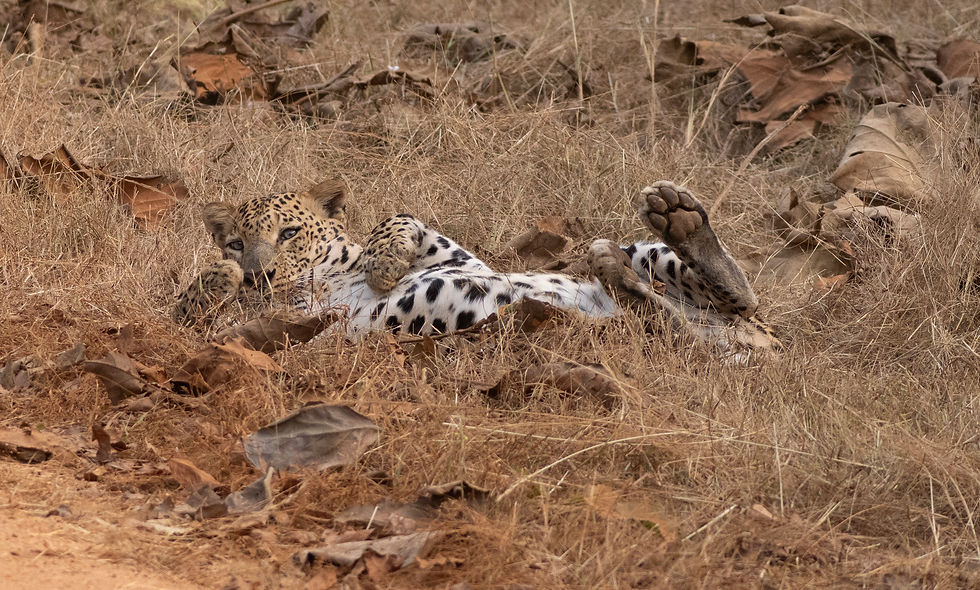
We arrived near a dam with little light left to hear that the Leopard was still present but there were two vehicles watching it. With the "don't crowd the wildlife" protocol in place we had to wait till one of the vehicles left. A nerve filled few minutes ensued as I watched the light going. I had my camera at the ready but the iso was already at 12800 so any pictures were going to be a real challenge, if the Leopard was even still there. Then a vehicle came out and their guide gave directions to where it was last seen (yes last seen) and wished us luck. We drove in ! I immediately saw it sitting by the edge of the damn. I alerted Sam Tom and Garrick to where it was and we edged a little closer. There is was, a Leopard, I was shaking with excitement. I fired off a few pictures but it was so dark I reverted to video which copes with low light levels much better. And then we just watched it as it stalked around the dam occasionally disappearing into the adjacent bush, to emerge several meters further.


This was my first picture.


After some post production with shadows and exposure in Lightroom I was able to retrieve these images.


The Leopard seemed to have an innate stealth about it as it suddenly disappeared from view and then re-emerged. The camouflage working in conjunction with this stealth made it so absorbing to watch, this was a secretive and solitary animal a true "cat of the night".


With no other vehicles waiting to come in we had a good 15 minutes with this fabulous animal. It was then truly dark. We returned to the lodge though I don't recall much about the drive back.


Dinner was as ever tasty and while Tom got stuck in I was a tad distracted wondering then if I'd be able to edit my near dark pictures to get a decent image. The combination of my Sony camera and editing programmes produced a shout of "blimey it's ok" as I looked at the new image on my laptop - I think I was half way through the starter when it happened. So laptop away and enjoy the great food on offer. Tom certainly did !


14 October - our last day and it started with some good sightings of more Lions a Striated Kingfisher and Broad-billed Roller.


A Black-bellied Korean was next

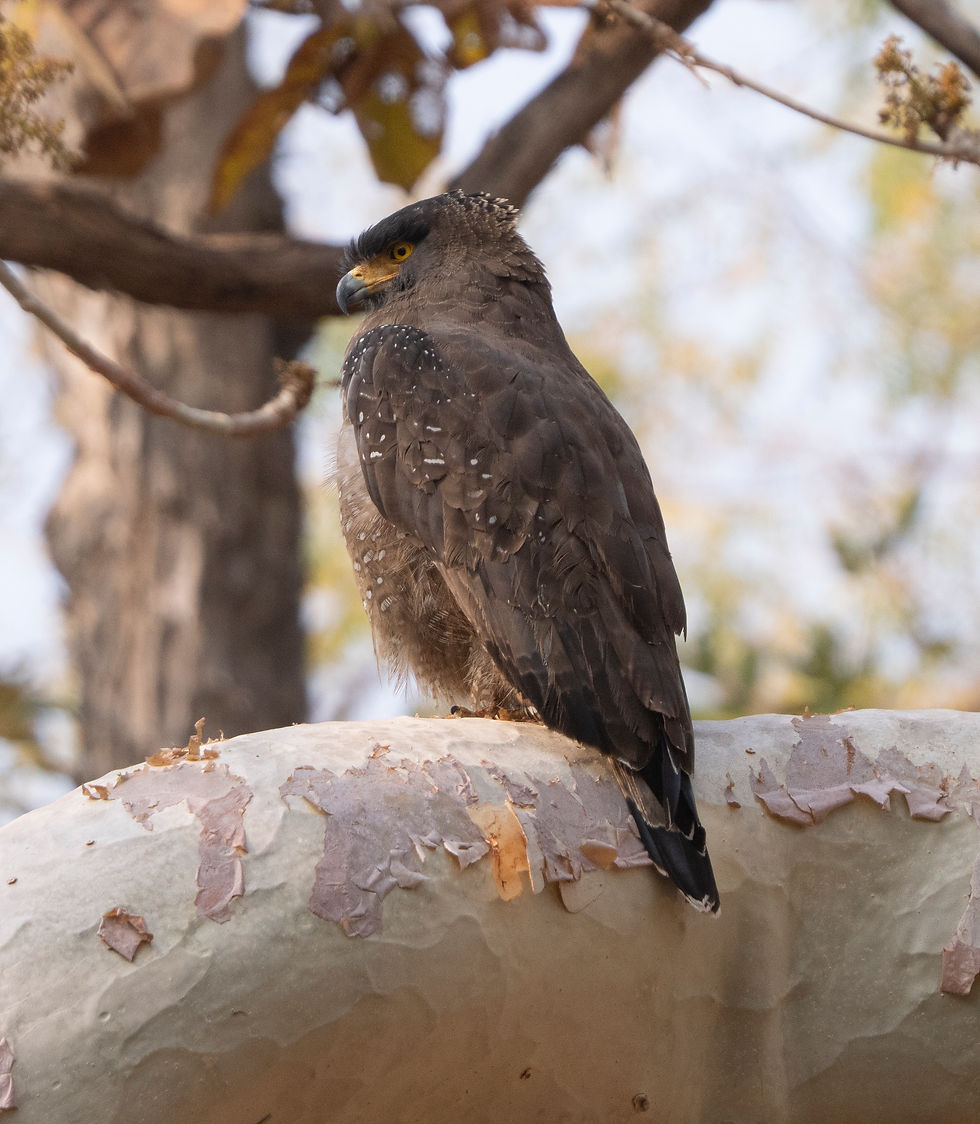
A snake Eagle living up to it's name

We stopped for our early morning coffee and rusks

Crowned Lapwing


Moving on a Crowned Hornbill was added to the list and more Zebra. I wanted a particular picture of a Zebra which I managed - more on why later.


This was the pic I was after (below) -


We came across a Giraffe chewing some bones. They do this to extract small quantities of minerals such as phosphorus and calcium which they need for their own bone development by sucking and chewing them. They don't swallow the bone just drop it when they've had enough of the minerals.


We finished our night time game drive with several sightings of Slender Mongoose.

Tomorrow was the early flight down to Cape Town so our time at Bayala had come to an end. I'm not really sure I have the correct adjectives to express how superb our time had been. The big five nailed and done so in a eco friendly, non rushed and quiet fashion. The lodge staff had been wonderful, the food superb. Tom had enjoyed the trip far more than I thought he would which also made the trip for me and Sam was delighted also with everything to do with this African adventure. I can highly recommend Bayala for a relaxing and exciting safari.


And here's what Sam did with that Zebra picture.......... ( now on sale in my shop! )

Next up - Cape Town

bottom of page